We have all been there: you smell an exquisite, woody sillage on a friend, purchase the same $300 bottle, only to find that on your skin, it turns into a cloying, synthetic mess. Finding a signature scent in 2026 is no longer about following trends or buying what’s “top-rated” on TikTok. It is an exercise in Olfactive DNA—a complex intersection of your skin’s biological profile and the psychological message you want to project. At Beaudoré, we believe your scent should be as unique as your fingerprint, acting as a silent, invisible introduction before you even speak.
Why Your “Olfactive Logo” Matters More Than Your Wardrobe
In an era of visual saturation, the sense of smell remains the most direct line to the human subconscious. This is because the olfactory bulb is physically connected to the amygdala and hippocampus—the brain’s command centers for emotion and memory. When you choose a signature scent, you aren’t just picking a “smell”; you are engineering how people remember you.
The Chemistry of “The One”: Why Skin pH Changes Everything
The most common frustration in luxury perfumery is the “scent shift.” Your skin is a living, breathing canvas with its own micro-environment.
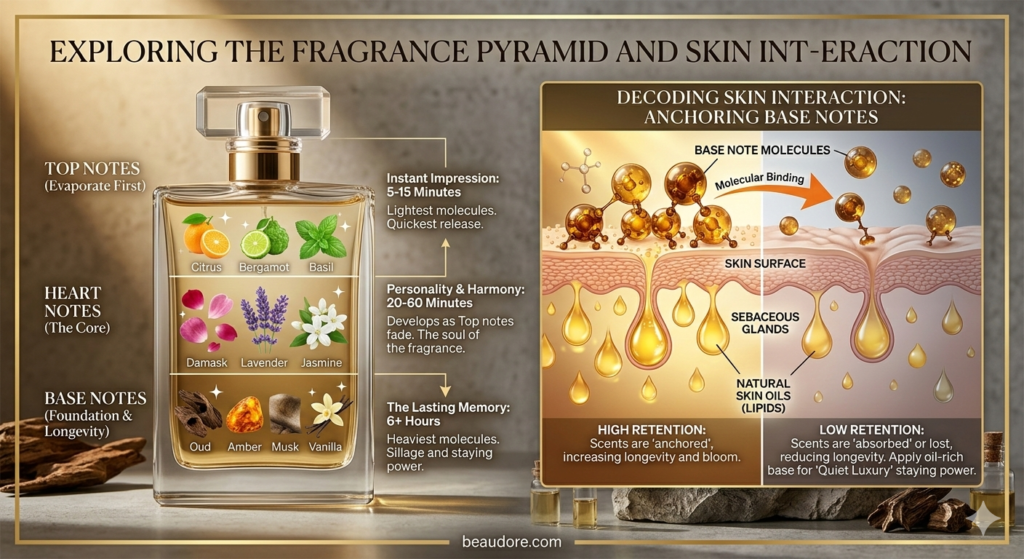
- The pH Variable: If your skin is more acidic, citrus and floral top notes will sharp-turn or evaporate almost instantly.
- Lipid Levels (Oiliness): Natural oils act as “anchors” for fragrance molecules. Dry skin “eats” perfume, which is why your long-lasting fragrance might disappear by lunchtime if you don’t prep the canvas.
- The Microbiome: Your unique skin bacteria break down essential oils differently, which is why a “sandalwood” note can smell creamy on one person and medicinal on another.
Decoding the Longevity Matrix: Concentration vs. Performance
To find a scent that survives a 12-hour day, you must understand the “Grade.” Most commercial scents are Eau de Toilette (EDT), but for a true signature scent that leaves a lasting impression, you should look for Extrait de Parfum.
| Concentration | Essential Oil % | Average Longevity | Best For |
| Eau de Parfum (EDP) | 15% – 20% | 5 – 8 Hours | Daily Office Wear |
| Extrait de Parfum | 20% – 40% | 10 – 24 Hours | Signature Identity |
| Fragrance Oil | 30%+ | 8 – 12 Hours | Close-contact/Intimate |
The Beaudoré Method: How to Test for Olfactory Accuracy
If you want to avoid “buyer’s remorse,” stop testing on paper strips. Paper doesn’t have a pulse.
- The 8-Hour Pulse Point Test: Apply the scent to your inner wrist and do not rub. Friction breaks the delicate molecular chains of the top notes.
- The Environment Audit: Wear the scent in three different settings: a temperature-controlled room, an outdoor space, and during a high-stress moment. Stress increases skin temperature, which “blooms” the base notes of a niche perfume more aggressively.
- The “Scent Wardrobe” Strategy: In 2026, the idea of having only one scent is becoming obsolete. Leading stylists now recommend a “Core Identity” (your base) and 2-3 fragrance layering options to adjust for the season or the occasion.
Mastering the Art of Fragrance Layering
To ensure no one ever “borrows” your scent, you must learn to layer. Start with a heavy, single-note base (like Musk or Amber) and top it with a lighter, complex floral or citrus. This creates a multidimensional sillage that is impossible to replicate. According to the experts at The Fragrance Foundation, layering is the ultimate expression of personal branding in the luxury sector.
Frequently Asked Questions (FAQ)
Q: Why can’t I smell my own perfume after an hour? A: This is “Olfactory Fatigue.” Your brain treats the constant scent as “background noise” to protect your senses. Others can still smell you—so don’t over-spray!
Q: Where is the best place to apply for maximum projection? A: Beyond the wrists, apply to the back of the neck and the “inner elbows.” These areas radiate heat consistently, helping the scent travel as you move.
Q: Do perfumes expire? A: Yes. Light and heat are the enemies of fragrance. Keep your luxury perfume in its original box or a dark drawer—never the bathroom—to maintain its chemical integrity for 3–5 years.
Final Thought: Your Scent is Your Legacy
A signature scent is the only accessory you wear that can trigger a memory years after you’ve left the room. By understanding your skin chemistry and moving toward high-concentration niche options, you aren’t just buying a product; you are claiming your space in the world.