
There is a particular kind of quiet frustration that comes not from a dramatic moment, but from a small one. A photograph taken at an angle you didn’t choose. The way the light fell in a hotel bathroom mirror. A colleague who looks, somehow, rested in a way you no longer do. You weren’t expecting to feel anything — and then, unexpectedly, you did.
If you’ve been navigating that feeling lately — and quietly wondering whether your skincare routine is still working the way it used to — you’re not imagining the shift. Your skin is genuinely operating under different biological rules than it did ten years ago. And the products and habits that served you at 30 may be doing very little for you at 42, not because they were wrong then, but because your skin has changed in ways that most skincare marketing never actually explains.
This guide exists to change that. Not with a list of miracle products or an overwhelming 12-step routine, but with a clear, honest understanding of what’s happening beneath the surface — and a skincare routine for aging skin that responds to your biology, not a trend cycle.
Key Takeaways
- Collagen production declines by approximately 1% per year after the age of 20, with the most visible effects typically appearing in the mid-30s to early 40s (source: Journal of Investigative Dermatology).
- Retinoids remain the most extensively peer-reviewed topical ingredient for addressing fine lines, skin texture, and uneven tone — but concentration and formulation type matter more than the name on the label.
- Skin barrier function declines with age, meaning the same exfoliants and actives that suited you at 28 may now cause more inflammation than improvement.
- Daily broad-spectrum SPF is, by a considerable margin, the single most evidence-backed anti-aging intervention available without a prescription.
- In luxury skincare, the categories most worth investing in are those where delivery system and formulation stability determine efficacy — specifically Vitamin C serums, retinoid products, and barrier-repair moisturizers.
What’s Actually Happening to Your Skin After 35
Before a routine can serve you well, it helps to understand what it’s working with.
Skin aging is not one single process — it’s the convergence of several simultaneous biological shifts, each happening at its own pace, each responding to a different set of interventions. Treating all of them with the same product, or worse, the same 10-step routine you’ve had since your late 20s, is one of the most common and costly mistakes in mature skincare.
The Collagen Timeline: When Loss Becomes Visible
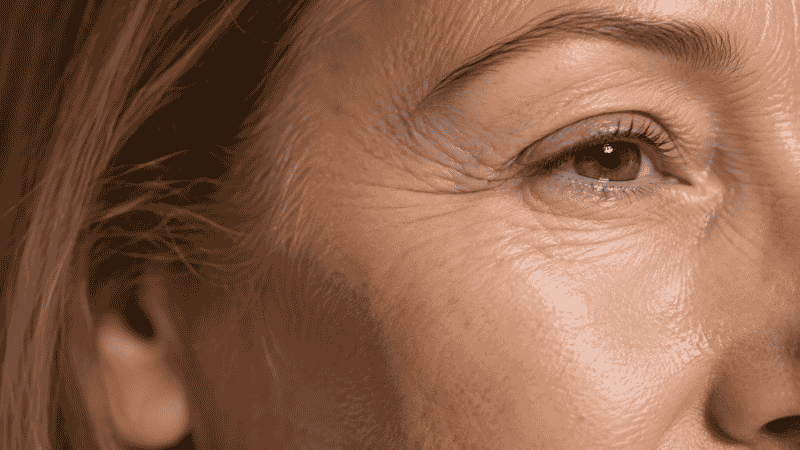
Collagen — the structural protein responsible for skin’s firmness and tensile strength — begins declining gradually from your early 20s. For most women, this loss is nearly imperceptible until the mid-30s, when cumulative UV exposure, hormonal shifts, and a slowing of cellular turnover begin to make the deficit visible. By the time fine lines appear around the eyes and mouth, or the skin at the jawline begins to feel less defined, collagen loss has typically been underway for over a decade.
This matters for product selection because topical collagen molecules cannot penetrate the dermis. They are too large. A moisturizer listing collagen as a hero ingredient is, at best, providing surface-level hydration. The ingredients that actually support collagen synthesis — retinoids, Vitamin C, certain peptides — work by stimulating your skin’s own production machinery, not by depositing collagen from the outside.
Why Your Old Products Stopped Working
This is the quiet mystery that brings many women to a new skincare routine in their 40s. The serum you loved for years seems to have simply… stopped doing anything. The moisturizer that kept you comfortable through your 30s now feels insufficient.
It isn’t the product that changed. Your skin’s cellular turnover rate slowed — from roughly every 28 days in your 20s to closer to 45–60 days in your 40s and beyond. This means that active ingredients take longer to show results, that dead skin cells accumulate more readily at the surface (contributing to dullness and an uneven texture), and that the skin’s capacity to absorb and utilise certain actives has shifted. A formula calibrated for a faster skin cycle may simply be underdelivering in a slower one.
Understanding this changes how you evaluate a product’s effectiveness — and how long you give it before making a judgment.
The Skincare Routine for Aging Skin — Built Around Biology
A well-designed routine for mature skin has one overriding principle: every step should either protect the barrier, support cellular renewal, or deliver a clinically supported active. Anything that doesn’t do at least one of those things is, at this stage of life, a luxury you don’t need.
Morning Ritual: Defense, Antioxidants, and the SPF Non-Negotiable
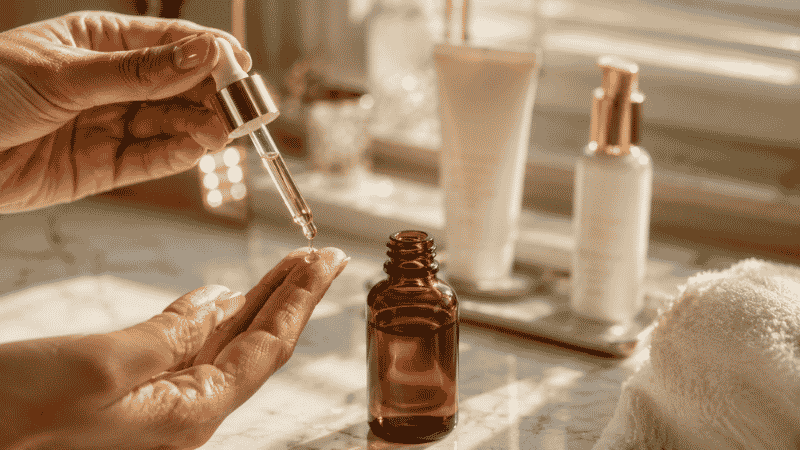
The purpose of a morning routine is protection, not treatment. Your skin’s circadian biology places it in a defensive mode during daylight hours — producing sebum, activating antioxidant enzymes, and priming itself against UV and environmental assault. Your products should work with this rhythm, not against it.
Step 1 — Cleanse gently, or don’t cleanse at all. If your skin is not visibly oily in the morning, a splash of lukewarm water is sufficient. Over-cleansing in the morning strips away the sebum your skin worked to produce overnight, which is particularly counterproductive for mature, drier skin types. If you prefer a cleanser, choose one that is fragrance-free, pH-balanced, and free from sulphates. The goal is to arrive at your next step with an intact barrier, not a squeaky-clean one.
Step 2 — Vitamin C serum. This is arguably the most important morning active for aging skin, and also the one with the most quality variation at every price point. A well-formulated Vitamin C serum — one with L-ascorbic acid at 10–20% concentration, a pH below 3.5, and opaque or airless packaging — provides meaningful antioxidant protection against UV-induced free radical damage, supports collagen synthesis, and addresses hyperpigmentation over time.
The reason to invest here: Vitamin C is notoriously unstable. Budget serums in clear packaging are frequently oxidised before you even open them. This is one of the categories where luxury formulations — with their controlled stabilisation technology, nitrogen-purged packaging, and bioavailable derivative forms — justify the premium.
Step 3 — Moisturiser appropriate for your skin type. In the morning, this step is primarily about sealing in the hydration from your previous steps and providing a smooth base. For mature skin, look for formulations containing ceramides (to reinforce the lipid barrier), glycerin (a reliable humectant that draws moisture to the surface), and ideally niacinamide at 4–5%, which addresses skin tone irregularities and strengthens barrier function simultaneously.
Step 4 — SPF 30 minimum, broad-spectrum, every day. This is not optional, and it is not a negotiable step. UV exposure is responsible for an estimated 80–90% of visible skin aging — not chronological aging, but the lines, spots, and textural changes that make skin look older than it is. According to research published in Annals of Internal Medicine, consistent daily sunscreen use demonstrably reduces the development of new signs of photoaging. No serum, no cream, no treatment counteracts ongoing UV damage. SPF comes last in the morning and receives no exceptions.
Editor’s note: If you find yourself skipping SPF because the texture doesn’t work under makeup, this is worth solving, not working around. The luxury SPF market has progressed significantly — lightweight, non-whitening mineral formulas now exist that genuinely disappear into mature skin. It’s worth a few trials to find one that becomes invisible in your routine.
Evening Ritual: When Repair Actually Happens
Your skin’s overnight mode is when cellular regeneration peaks. This is when retinoids are most effective, when barrier-repair ingredients do their deepest work, and when your most treatment-focused products earn their place. The evening routine can be slower, more intentional. It doesn’t need to be fast.
Step 1 — Double cleanse (if wearing SPF and/or makeup). Begin with an oil-based cleanser or cleansing balm to dissolve sunscreen and any makeup residue. Follow with a gentle water-based cleanser. For evenings when you haven’t worn SPF or makeup, a single gentle cleanse is sufficient. The goal is a clean surface without barrier compromise.
Step 2 — Targeted treatment (retinoid or alternative). This is the most consequential step in an anti-aging routine. Retinoids — the umbrella term encompassing prescription tretinoin, retinaldehyde, and over-the-counter retinol — are the most rigorously studied topical actives for addressing fine lines, skin thickness, and uneven tone. A 2019 study in the British Journal of Dermatology confirmed that consistent retinoid use over 12 weeks produces measurable improvements in collagen density and epidermal thickness.
If you are new to retinoids, begin at the lowest available concentration — typically 0.025% retinol or 0.05% retinaldehyde — applied every third night, on fully dry skin, buffered with a light moisturiser on sensitive areas. This is not timidity; it is the protocol that allows your skin to adjust without the inflammation that derails so many people before they see results. Increase frequency over 8–12 weeks, guided entirely by how your skin responds.
Step 3 — A barrier-sealing moisturiser. After retinoid application, your barrier needs support. Look for formulations centred on ceramides, fatty acids, and cholesterol — the three components of the skin’s own lipid matrix. This is where a genuinely rich, science-led moisturiser earns its place in a mature skincare routine. Augustinus Bader’s TFC8 technology, SkinCeuticals’ Triple Lipid Restore, and La Mer’s formulations all address this category — with different mechanisms and significantly different price points. We’ve evaluated each in detail [→ link to Worth It comparison article].
Where Luxury Skincare Is Actually Worth the Investment
This is the question that sits underneath most luxury skincare decisions, even when it’s not explicitly asked. The honest answer is: it depends entirely on the category.
Worth the investment:
Vitamin C serums — Stability and bioavailability are directly tied to formulation quality and packaging. This is where luxury formulations demonstrably outperform budget alternatives.
Retinoid products — Encapsulation technology in premium retinol products reduces irritation while maintaining efficacy. For sensitive or reactive mature skin, this is a meaningful functional difference, not a marketing claim.
Barrier-repair moisturisers — The ratio and purity of ceramides, the molecular weight of the fatty acids used, and the absence of destabilising fragrance all matter more at this level. A $280 barrier cream that genuinely functions differently from a $45 alternative is a real phenomenon — but requires knowing which products have the evidence to support the claim.
Where you can spend less without compromise:
Cleansers — Active ingredients in a cleanser are on your skin for 30 seconds before being rinsed away. A gentle, fragrance-free formula is all that’s needed, regardless of price point.
Physical SPF — Zinc oxide at adequate concentration works the same at every price point. The premium here buys you texture and aesthetics, not photoprotection.
Basic hyaluronic acid serums — The molecule is inexpensive to produce. A $25 HA serum can perform identically to a $120 one, provided the molecular weight and formulation are appropriate.
Skincare by Decade: Because 35 and 55 Are Not the Same Skin
One of the most significant failures of generic anti-aging content is that it addresses “mature skin” as if it were a single category. It is not. The biological priorities of skin in the mid-30s are meaningfully different from those in the mid-50s, and a routine built without that distinction is, at best, partially effective.
In Your 30s: Building the Foundation
Your 30s are the decade of early intervention and habit formation. Collagen loss is underway but the visible effects are typically subtle — slightly less resilience, the beginning of fine lines in high-movement areas, perhaps a loss of that effortless glow that required no effort at all a few years ago.
The priorities: Establish a non-negotiable SPF habit if you haven’t already. Introduce a low-concentration retinoid — consistently, not sporadically. Focus on antioxidant protection in the morning. This decade is not about reversing significant damage; it is about slowing accumulation. The return on investment here is genuinely long-term.
In Your 40s: Responding to Real Shifts
By the early 40s, the changes are no longer subtle. Skin thickness has decreased. Cellular turnover is slower. For many women, perimenopause begins to affect oestrogen levels, which directly impacts skin hydration and collagen support. This is the decade where the routine needs to become more intentional — not more complex, but more precisely chosen.
The priorities: Upgrade your retinoid to a higher concentration if you’ve been using retinol for several years, or consider transitioning to retinaldehyde, which sits between OTC retinol and prescription tretinoin in potency. Prioritise barrier repair with ceramide-centred moisturisation. Consider adding a targeted peptide serum — signal peptides in particular, which communicate with fibroblasts to stimulate collagen production, have a reasonable body of evidence behind them. And address hyperpigmentation systematically if it’s appeared: consistent Vitamin C in the morning, consistent SPF, and a targeted brightening active (alpha arbutin or tranexamic acid) in the evening if needed.
In Your 50s: Rethinking the Framework
Post-menopausal skin operates under a genuinely different set of rules. Oestrogen decline accelerates both collagen and moisture loss. Skin that was previously resilient to certain actives may now be more reactive. The 10-step routine that a 50-year-old friend swears by may be too much for your own skin at this stage — not because your skin is weaker, but because its barrier tolerance has changed.
The priorities: Simplify and deepen, rather than add more steps. A cleanser, a prescription retinoid (if tolerated), a ceramide-rich moisturiser, and SPF is a complete routine. Everything else is optional enhancement. If dryness is your primary concern, consider face oils — specifically squalane (which closely mimics the skin’s own lipids) and marula oil (rich in oleic acid) — layered over your moisturiser as a final seal rather than as a replacement for it.
The Anti-Aging Ingredients Science Consistently Supports
The skincare ingredient landscape is crowded with promising names and innovative nomenclature. For mature skin, the shortlist of ingredients with genuine, replicated clinical evidence is considerably shorter than most brands would prefer you to believe.
Retinoids — The most comprehensively studied topical anti-aging ingredient in existence. Accelerates cellular turnover, stimulates collagen synthesis, addresses hyperpigmentation, and improves skin texture. Requires consistent use over 12+ weeks to assess results. Start low, go slow.
Vitamin C (L-ascorbic acid) — Antioxidant protection, collagen support, and pigmentation correction. Efficacy is entirely dependent on formulation stability and concentration. 10–20% L-ascorbic acid in stable, opaque packaging is the target.
Niacinamide — Improves barrier function, reduces hyperpigmentation, regulates sebum, and has anti-inflammatory properties. Effective at 4–5%. One of the most versatile and well-tolerated actives for mature skin.
Peptides — The evidence is more nuanced here than marketing suggests, but certain peptide types — specifically Matrixyl (palmitoyl pentapeptide-4) and Argireline (acetyl hexapeptide-3) — have studies supporting their role in skin firmness and wrinkle reduction. Look for them listed early in the ingredient list (indicating meaningful concentration) in serum formulations.
Ceramides — Not a treatment active, but foundational. Ceramides at a physiological ratio (ceramide NP, AP, and EOP) support the skin’s own barrier repair function and are essential in any mature skin moisturiser.
Broad-spectrum SPF — It bears repeating because the evidence is so consistent: this is the anti-aging intervention with the strongest and most replicated scientific support available without a prescription.
When Your Routine Isn’t Working — And What to Do Instead
If You Only Have 10 Minutes
A stripped-back routine is not a failed routine. If your mornings are consistently demanding, this is your non-negotiable four-step minimum: gentle cleanse (or just water), Vitamin C serum, moisturiser with SPF. That’s it. Applied consistently, this outperforms a 10-step routine done sporadically every time.
In the evening, if time is short, prioritise the retinoid step over everything else. A cleanser and a retinoid, followed by moisturiser, is a complete and effective anti-aging routine.
If You’ve Tried Everything and Nothing Seems to Work
This is where honest self-assessment is more valuable than another new product. Consider:
Are you consistent? Retinoids require 12–16 weeks of consistent use before meaningful improvement becomes visible. If you’ve been using something for three weeks and stopped because you didn’t see results, you didn’t give the active long enough to demonstrate its effect.
Is your barrier intact? If your skin is reactive, tight, flushing easily, or persistently flaky, you may be working with a compromised barrier. In this state, actives are more likely to irritate than to treat. Strip back to basics — cleanser, ceramide moisturiser, SPF — for 4–6 weeks before reintroducing actives.
Are you using too many actives? More is not more, in mature skincare. Layering Vitamin C, retinol, an AHA, and a peptide serum in the same routine doesn’t multiply the results — it frequently multiplies the irritation. One primary active per session (retinoid at night, Vitamin C in the morning) is the architecture that lets each ingredient work.
When to Seek Professional Guidance
A well-chosen skincare routine is a meaningful and genuinely effective investment in your skin’s long-term health. It is not, however, a substitute for professional dermatological care in certain circumstances.
Consider seeking a consultation if: you notice any changes in existing moles or the appearance of new pigmented lesions (always warranting evaluation); if persistent redness, itching, or sensitivity doesn’t resolve after 6 weeks of simplified barrier-first care; if you’re interested in prescription-strength retinoids, which offer a meaningfully higher level of efficacy than over-the-counter formulations; or if you’re considering in-office treatments — laser resurfacing, chemical peels, or injectables — which sit outside the scope of topical skincare and benefit significantly from professional assessment of skin type, tone, and history.
FAQ
At what age should I start an anti-aging skincare routine? The honest answer is that the most effective anti-aging measure — daily SPF — should ideally start in your 20s. For targeted actives like retinoids and antioxidant serums, the mid-to-late 20s is a reasonable starting point. That said, there is no age at which beginning is pointless. Skin at 50 responds to retinoids. Skin at 60 benefits from ceramide repair. Starting later simply means acknowledging where you are and building from there.
Can I use retinol every night for aging skin? Eventually, yes — for most people. But “every night from week one” is not the protocol that leads to best results. Begin with two to three nights per week, on fully dry skin, at the lowest available concentration. Increase frequency only when your skin has adapted without irritation, which typically takes 8–12 weeks.
Is a separate eye cream necessary, or is my regular moisturiser sufficient? The skin around the eye is thinner and more sensitive than the rest of the face, and does benefit from a lighter, more precisely formulated product — particularly one containing caffeine (for puffiness), peptides (for firmness), and without the heavier occlusives that can cause milia in that area. A dedicated eye cream is not a marketing invention; it’s addressing genuinely different skin with a genuinely different formula. That said, a good retinol serum applied carefully to the orbital area also addresses fine lines — eye creams are not the only route.
What’s the difference between retinol and retinaldehyde? Both are forms of Vitamin A, but they sit at different points on the conversion pathway. Retinol must convert to retinaldehyde, then to retinoic acid (the active form) before the skin can use it. Retinaldehyde is one step closer to active form, making it more potent than retinol at equivalent concentrations, but also more likely to cause initial sensitivity. It is often recommended as the step between OTC retinol and prescription tretinoin for those who find retinol insufficient but aren’t yet ready for prescription strength.
Can I use Vitamin C and niacinamide together? Yes. The concern that Vitamin C and niacinamide “cancel each other out” is based on outdated chemistry research involving concentrations far higher than those used in skincare products. At standard formulation percentages, they can be layered without issue — though applying Vitamin C first and allowing it to absorb before applying niacinamide is a reasonable practice.
Why does my skin feel drier in my 40s even though I’m using the same moisturiser? Because your skin is producing less sebum, and possibly experiencing oestrogen-related hydration decline. The same moisturiser that created a balanced environment in your 30s may now be insufficient for a skin that retains moisture less efficiently. Look for formulations that combine humectants (hyaluronic acid, glycerin) with emollients (fatty acids, squalane) and occlusives (ceramides, shea butter) — a three-tier approach to hydration that addresses moisture attraction, softening, and retention simultaneously.
How long before I see results from a new skincare routine? For SPF: immediately, in terms of protection (though the effect on existing damage takes months to years). For Vitamin C: 4–8 weeks for visible brightening, 12+ weeks for collagen-related improvements. For retinoids: 12–16 weeks of consistent use for meaningful changes in texture and line depth. For moisturisers: hours, for hydration; weeks, for barrier repair. Patience is not passive in skincare — it’s the actual mechanism.
Building From Here
A skincare routine for aging skin is not a fixed destination. It’s a framework that evolves — with your skin’s biology, with the seasons, with the gradual introduction of more potent actives as your skin adapts. The goal is not perfection. It’s consistency, clarity, and the quiet satisfaction of knowing that what you’re applying is actually doing what you think it is.
If you’re ready to go deeper into any aspect of this routine, the following guides on Beaudore may be useful next steps:
- [→ Retinol for Mature Skin: How to Start, What to Expect, and When to Upgrade]
- [→ The Honest Comparison: La Mer vs Augustinus Bader — Which Is Worth $290?]
- [→ Vitamin C Serums Ranked by Stability: What the Formula Actually Tells You]
- [→ Luxury Skincare Routine for Women in Their 40s: A Step-by-Step Framework]
Luxury skincare should never feel like a gamble. When the science is clear, the decisions become straightforward.
References
- Ganceviciene, R., et al. (2012). Skin anti-aging strategies. Dermato-Endocrinology, 4(3), 308–319. https://doi.org/10.4161/derm.22804
- Hughes, M.C.B., et al. (2013). Sunscreen and prevention of skin aging: A randomized trial. Annals of Internal Medicine, 158(11), 781–790.
- Mukherjee, S., et al. (2006). Retinoids in the treatment of skin aging. Clinical Interventions in Aging, 1(4), 327–348.
- Chaudhuri, R.K., & Bojanowski, K. (2014). Bakuchiol: A retinol-like functional compound. International Journal of Cosmetic Science, 36(3), 221–230.
- Baumann, L. (2007). Skin ageing and its treatment. Journal of Pathology, 211(2), 241–251. https://doi.org/10.1002/path.2098