
Notice a new brown spot on your cheek, forehead, or the back of your hand and wonder whether it’s just a sunspot or something more serious. In most cases, these flat, dark patches are harmless sunspots caused by years of cumulative UV exposure rather than aging itself. However, not every pigmented spot is a sunspot, and learning to tell the difference is essential before starting any treatment or assuming it’s only a cosmetic concern.
This guide will help you tell a typical sunspot on skin apart from conditions that deserve medical attention, understand why these spots often appear years after the sun exposure that caused them, and build an advanced, dermatologically sound approach to brightening and skin rejuvenation — the kind that respects both safety and results.
A note on safety before we go further: any spot that is changing in size, shape, or color, has an irregular or asymmetrical border, appears unusually dark, or is bleeding, crusting, or persistently rough should be evaluated by a qualified dermatologist before any cosmetic treatment is considered. Nothing in this guide replaces a professional diagnosis.
Overview: The Quick Answer
Sunspots are typically flat, smooth patches of tan, brown, or darker pigmentation that develop on chronically sun-exposed skin, caused primarily by cumulative UV exposure rather than the passage of time alone. They are usually harmless, but “usually” is the operative word — which is why identification always comes before treatment.
A one-second identification guide:
| What you observe | What it likely suggests |
|---|---|
| Flat, smooth, stable, uniform in color | Consistent with a typical sunspot |
| Rough, scaly, or crusty texture | May indicate actinic keratosis — requires medical evaluation |
| Asymmetrical, irregular border, multiple colors, or visibly changing | Requires prompt dermatological assessment |
Are sunspots dangerous? Typical sunspots are generally benign. But a spot that looks similar at first glance can, in some cases, represent a different condition entirely. Cosmetic treatment — serums, peels, lasers — should only begin once any suspicious lesion has been properly assessed by a professional.
A simple decision guide for sorting a cosmetic concern from a dermatological one:
- Check the texture — is it smooth or rough?
- Check the symmetry and border definition.
- Check for color variation within the spot.
- Check whether it has changed recently.
- If any warning sign is present, prioritize a professional evaluation before anything else.
What Are Sunspots on Skin?
Sunspots are one of the most common forms of UV-related pigmentation, yet the terminology around them causes real confusion. Patients often arrive at a dermatologist’s office unsure whether the term “age spot” means something different from “sunspot,” or whether either term should worry them. It’s a fair question, because the language hasn’t kept pace with the science.
Sunspots, Age Spots, Liver Spots, and Solar Lentigines
These four names are largely used interchangeably to describe the same type of UV-induced pigmented spot, medically referred to as solar lentigines. The name “age spot” is the most misleading of the group — it implies that aging itself is the cause, when in fact these spots are driven overwhelmingly by cumulative sun exposure. Age simply provides more time for that exposure to accumulate.
What Do Sunspots Typically Look Like?
A typical sunspot presents as:
- A flat, smooth surface with no raised texture
- Tan, light brown, dark brown, or occasionally deeper pigmentation
- Well-defined, even borders
- A location on chronically exposed skin — the face, hands, shoulders, arms, chest, and décolletage
Why Can Sunspots Appear in Your 30s or 40s?
It’s a common misconception that sunspots are strictly a concern for people over 50. In reality, cumulative UV exposure has a delayed expression — the pigmentation triggered by sun exposure in your twenties may not become visible for another decade or two. Many women notice their first sunspots in their 30s or 40s, often alongside other early signs of photoaging: uneven tone, subtle dryness, the first fine lines, and a general loss of radiance. The spot itself is rarely an isolated event; it’s usually one visible signal among several.
What Causes Sunspots on Skin?
The primary driver of sunspots is cumulative ultraviolet exposure, while genetics and skin type determine how visibly and how quickly that exposure translates into pigmentation.

Cumulative UVA and UVB Exposure
Repeated UV exposure stimulates melanocytes — the pigment-producing cells in the skin — to generate more melanin as a protective response. Over years, this repeated stimulation can result in localized, concentrated pigment deposits. This is why summers spent tanning, years of outdoor sport, or inconsistent sunscreen use in earlier decades often surface as visible spots much later.
Why Sun Damage Can “Catch Up” With You Years Later
UV damage accumulates quietly. It doesn’t announce itself the way a sunburn does — instead, it builds in the deeper layers of the skin over years, and pigmentation appears once that accumulated damage crosses a visible threshold. This explains a very common experience: noticing several new spots after a single summer, even though the underlying damage was almost certainly building for far longer. The trigger may be recent; the cause rarely is.
Genetics, Skin Tone, and Individual Susceptibility
Lighter skin tones tend to show UV-related pigmentation more readily, simply because they have less baseline melanin to begin with. That said, individual pigmentation response varies considerably — two people with similar sun exposure histories and similar skin tones can develop noticeably different degrees of visible sunspots, a variation largely explained by genetics.
The Broader Connection Between Sunspots and Photoaging
Sunspots rarely exist in isolation. They tend to travel with:
- UV-induced oxidative stress at the cellular level
- Gradual collagen degradation and loss of firmness
- Chronic, low-grade inflammatory processes associated with long-term photoaging
This is precisely why treating the spot in isolation — without addressing the surrounding skin — tends to produce underwhelming, short-lived results. A sunspot is often a marker of broader photoaging, not an isolated cosmetic flaw.
Sunspots vs. Melasma vs. Post-Inflammatory Hyperpigmentation: How Can You Tell the Difference?
Correct identification matters enormously before reaching for strong actives, chemical peels, or energy-based treatments, because each of these three conditions responds differently — and some respond poorly, or even worsen, with the wrong approach.
Sunspots are typically discrete, well-defined, and localized, closely tied to a history of chronic sun exposure in that specific area.
Melasma tends to present as broader, patchy, and often symmetrical areas of pigmentation, frequently on the cheeks, forehead, or upper lip. It can be triggered or worsened by both sun exposure and hormonal factors, and it has a reputation for responding unpredictably — sometimes worsening — with aggressive energy-based treatments like certain lasers.
Post-Inflammatory Hyperpigmentation (PIH) typically follows an inflammatory event: acne, irritation, an injury, or overly aggressive skincare. This is worth pausing on, because over-exfoliation is a frequent, under-recognized cause of PIH — the very routine intended to brighten the skin can end up darkening it further.
| Feature | Sunspots | Melasma | Post-Inflammatory Hyperpigmentation |
|---|---|---|---|
| Typical pattern | Discrete, localized spots | Broader, often symmetrical patches | Follows the shape of prior irritation or injury |
| Common triggers | Chronic cumulative UV exposure | UV exposure + hormonal factors | Acne, injury, inflammation, over-exfoliation |
| Treatment considerations | Generally responds well to topical brightening and prevention | Requires a cautious, gradual approach; aggressive treatments can worsen it | Requires gentle, barrier-supportive care first |
| Risk of worsening with irritation | Low to moderate | High | High |
Quick tip: don’t assume that every dark patch that appeared after summer is automatically a sunspot. Hormonal shifts, recent irritation, and inflammatory triggers can produce a visually similar result with a very different treatment path.
Sunspots vs. Skin Cancer: The ABCDE Guide to Warning Signs
This is, without question, the most important section of this guide before any conversation about cosmetic treatment begins.
Sunspots vs. Actinic Keratoses
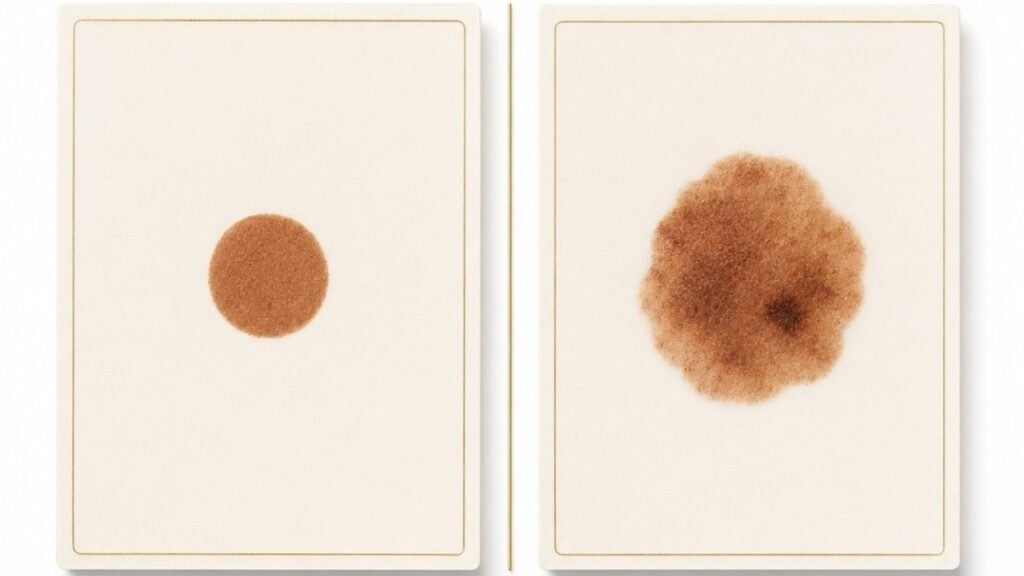
A typical sunspot is flat and smooth. An actinic keratosis, by contrast, often feels rough, scaly, crusted, or sandpaper-like to the touch — a texture difference that is often more telling than color alone. Actinic keratoses are considered precancerous and warrant medical evaluation rather than at-home treatment.
Sunspots vs. Melanoma
Melanoma can, in some cases, closely resemble an ordinary pigmented spot in its early stages. This is precisely why visual self-checking — however careful — is not a substitute for a professional diagnosis. A dermatologist has tools, training, and often dermoscopy equipment that go well beyond what the eye alone can determine.
The ABCDE Rule
This widely used framework helps flag lesions that deserve professional attention:
- A — Asymmetry: one half doesn’t match the other
- B — Border: edges are irregular, notched, or poorly defined
- C — Color: more than one shade, or uneven color distribution
- D — Diameter: larger than roughly the size of a pencil eraser
- E — Evolving: any change in size, shape, color, or texture over time
When to Seek Dermatological Evaluation
Book an appointment promptly if you notice:
- A spot that changes in size, shape, color, or texture
- A new or unusual lesion, especially one that appeared quickly
- Persistent bleeding, crusting, tenderness, or itching
- A spot that looks noticeably different from your other marks — sometimes called the “ugly duckling” sign
Warning: do not use high-strength brightening products, at-home peels, or laser treatments on a suspicious lesion before it has been professionally evaluated. Cosmetic intervention on an unassessed lesion can delay proper diagnosis.
How to Prevent Sunspots and Further Photoaging
Prevention is the foundation of every effective pigmentation and anti-aging strategy — no serum, however advanced, can outperform consistent sun protection.
Use Broad-Spectrum SPF 30+ Consistently
Apply daily to the face, neck, chest, and hands, and reapply according to sun exposure, sweating, and time spent outdoors. This single habit does more for long-term pigmentation prevention than any single active ingredient.
Do Not Rely on Weather or Indoor Location Alone
UVA rays penetrate cloud cover and glass, meaning meaningful exposure still occurs on overcast days and near windows — a detail many skincare routines overlook entirely.
Add Physical Sun Protection
- Wide-brimmed hats
- Protective, tightly woven clothing
- Sunglasses
- Deliberately seeking shade during peak UV hours
Protect the “Forgotten” Areas
Sunscreen application often stops at the jawline. Extend it consistently to the:
- Hands
- Neck
- Décolletage
- Ears and hairline, where relevant
Premium sun shield decision guide — when selecting a high-end sunscreen, weigh:
- Genuine broad-spectrum protection
- Cosmetic elegance and finish under makeup
- Practicality for reapplication throughout the day
- Compatibility with sensitive or reactive skin
- Layering compatibility with the rest of a luxury skincare routine
Seasonal tip: increase sun-protection discipline during spring and summer, and around travel, beach vacations, and skiing trips — environments where UV intensity is easy to underestimate.
What Ingredients Can Fade Sunspots and Support Advanced Photoaging Repair?
It’s worth distinguishing between two related but different goals: reducing the visible appearance of existing pigmentation, and repairing the broader visible effects of photoaging around it. A well-built routine addresses both.

Vitamin C and Advanced Antioxidant Defense
Vitamin C supports antioxidant protection against UV-induced oxidative stress and contributes to a brighter-looking complexion over time. With this ingredient in particular, formulation quality matters more than headline concentration — stability, delivery system, and tolerability determine whether it performs as intended once applied to skin.
Retinoids and Retinol
Retinoids support cellular renewal and gradually improve the appearance of uneven tone and texture. For mature or sensitive skin, a gradual introduction — lower frequency at first, building tolerance over weeks — tends to produce better long-term adherence than an aggressive start.
Tranexamic Acid
Increasingly featured in targeted pigmentation formulas, tranexamic acid appeals to those seeking a more focused approach to uneven tone, often used alongside — rather than instead of — broader antioxidant and renewal strategies.
Niacinamide
A well-tolerated ingredient that supports a more even-looking complexion while also reinforcing skin barrier function, making it a versatile addition across skin types.
Kojic Acid and Other Pigment-Focused Actives
These ingredients can offer additional support for uneven tone, though tolerability varies by individual — introducing them gradually and monitoring the skin’s response is a sound approach.
High-End Antioxidant and Cellular-Support Ingredients
Premium formulations increasingly feature:
- Ergothioneine
- Advanced botanical extracts
- Proprietary peptide complexes
- Sophisticated multi-antioxidant systems
Premium positioning should be evaluated through formulation quality, stability, delivery technology, and available evidence — not through ingredient rarity alone. An exotic-sounding ingredient in an unstable formula offers little advantage over a well-formulated, familiar one.
Encapsulation and Delivery Technology
How an active ingredient is delivered often matters as much as the ingredient itself. Encapsulation and controlled-release technologies can improve stability and reduce irritation, allowing premium formulations to combine multiple actives while still prioritizing comfort and tolerability.
| Ingredient | Primary role | Best suited for | Main tolerability consideration | Role in a luxury anti-photoaging routine |
|---|---|---|---|---|
| Vitamin C | Antioxidant defense, brightening | Most skin types | Formulation stability affects performance | Morning defense layer |
| Retinoids/Retinol | Cellular renewal, texture | Uneven tone and early fine lines | Requires gradual introduction | Evening renewal step |
| Tranexamic Acid | Targeted pigment support | Persistent, localized discoloration | Generally well tolerated | Targeted evening or morning treatment |
| Niacinamide | Barrier support, tone evenness | Nearly all skin types, including sensitive | Very well tolerated | Layerable morning or evening step |
| Kojic Acid | Pigment-focused brightening | Those seeking additional tone support | Can cause sensitivity in some users | Complementary treatment |
| Advanced antioxidants (ergothioneine, peptides) | Cellular protection and support | Mature or photoaged skin | Depends on formulation quality | Foundation of premium serums and creams |
How to Build a Luxury Skincare Ritual for Sunspots and Photoaging
The most effective approach treats the face, neck, and hands as one connected system, rather than isolating a single spot for correction.
Morning: Antioxidant Defense + Brightening + Premium UV Protection
- Gentle cleanser
- Antioxidant or brightening serum
- Barrier-supporting, hydrating treatment
- Eye-area care, if part of your routine
- Face and neck moisturizer
- Broad-spectrum sunscreen
- Dedicated hand protection
Evening: Renewal + Repair + Rejuvenation
- Thorough but non-stripping cleansing
- Targeted brightening or pigment-supporting serum
- A retinoid or carefully selected renewal active, matched to tolerance
- Rich, barrier-supporting moisturizer
- Extended treatment applied to the neck and hands
The “Early C + Evening A” Luxury Routine Concept
A useful shorthand for this entire structure: antioxidant defense (vitamin C and related actives) in the morning, renewal and repair (retinoids and pigment-focused treatments) in the evening, with daily UV protection as the non-negotiable foundation connecting both.
Beginner mistakes to avoid:
- Using strong brightening actives without consistent sunscreen
- Combining too many exfoliating products at once
- Increasing retinoid frequency too quickly
- Treating all pigmentation as though it were the same condition
- Starting aggressive procedures without a professional assessment first
Sensitive or Mature Skin Adaptation
- Introduce one new active at a time
- Prioritize barrier support before pursuing stronger actives
- Reduce frequency rather than abandoning a potentially effective ingredient altogether
- Avoid treating irritation as proof that a product is “working” — it isn’t
Can Professional Treatments Remove Stubborn Sunspots Faster?
For persistent or more extensive pigmentation, professional procedures can offer faster, more concentrated results than topical skincare alone — but diagnosis always comes before treatment selection.
IPL for Sun-Related Pigmentation
Intense pulsed light can offer meaningful improvement for suitable candidates, though outcomes depend heavily on accurate diagnosis, skin type, device settings, and the expertise of the practitioner performing the treatment.
Picosecond Laser and Other Laser-Based Options
Different laser technologies target pigmentation through different mechanisms, which is why individualized treatment planning — rather than a one-size-fits-all protocol — tends to produce more predictable, satisfying results.
Cryotherapy and Other Dermatological Treatments
For certain lesions, a dermatologist may consider targeted, lesion-specific treatments such as cryotherapy, particularly when a spot has features that warrant closer management beyond cosmetic correction.
Skincare vs. In-Office Procedures: Decision Guide
- Mild, stable pigmentation: consistent skincare and disciplined sun protection may be entirely sufficient.
- Persistent or more pronounced pigmentation: professional evaluation and in-office options are worth considering.
- Any suspicious lesion: medical assessment must come before any cosmetic treatment.
| Luxury skincare | IPL | Laser-based treatments | Other dermatological procedures | |
|---|---|---|---|---|
| Downtime | None | Minimal | Varies by device | Varies |
| Speed of visible results | Gradual, over weeks to months | Faster, often within weeks | Faster, device-dependent | Case-dependent |
| Maintenance | Ongoing daily routine | Periodic sessions | Periodic sessions | Case-dependent |
| Best suited for | Mild to moderate, stable pigmentation | Confirmed sunspots in suitable candidates | Persistent, well-diagnosed pigmentation | Specific lesions requiring medical management |
| Risk considerations | Low, when used correctly | Requires correct diagnosis and settings | Requires individualized planning | Requires professional oversight |
Warning: the wrong treatment for the wrong type of pigmentation can worsen discoloration, particularly when the underlying condition has been misidentified. This is why the identification sections above matter as much as the treatment sections that follow them.
How to Choose High-End Products for Sunspots Without Paying for Hype
The most useful shift a discerning skincare buyer can make is moving away from “most expensive product” and toward “best-supported premium formulation.”
Evaluate the Formula, Not Just the Ingredient List
Consider stability, delivery system, ingredient compatibility, evidence of testing, and real-world tolerability — a headline ingredient means little if the formulation around it undermines its effectiveness.
Look for Evidence of Formulation Quality
- Product testing and quality assurance
- Transparent rationale for why specific ingredients were chosen and combined
- Clinical or instrumental testing where available
- Realistic, measured claims rather than promises of overnight transformation
Prioritize Tolerability for Mature and Sensitive Skin
A product used consistently, without irritation, will generally outperform a stronger product that’s abandoned after two weeks of discomfort. Consistency is the quiet variable behind most visible skincare results.
Luxury product evaluation checklist:
- Does it provide meaningful UV protection, or complement a complete protection strategy?
- Are the active ingredients formulated for stability?
- Is the formula designed with long-term, daily use in mind?
- Does the texture genuinely encourage consistent application?
- Is the price justified by formulation technology and evidence, rather than branding alone?
- Does it address both visible pigmentation and the broader signs of photoaging around it?
FAQ
Are the dark spots on my face sunspots, age spots, or melasma, and how can I tell the difference? Sunspots and age spots are essentially the same thing — discrete, flat, well-defined marks caused by cumulative sun exposure. Melasma tends to appear as broader, often symmetrical patches, frequently influenced by hormonal factors as well as sun exposure. If your pigmentation is patchy, widespread, and appears on both sides of the face in a mirrored pattern, melasma is more likely, and it’s worth a professional opinion before choosing treatments, since aggressive approaches can worsen it.
Do sunspots appear suddenly due to aging, or is it accumulated sun damage from years ago finally showing up? It’s almost always the latter. Sunspots reflect cumulative UV exposure that builds quietly over years before crossing a visible threshold. Age doesn’t cause them directly — it simply provides more time for that exposure to accumulate and eventually surface.
My face got covered in dark patches over the summer. What is the fastest, most effective way to get rid of them? There is no genuinely fast fix that’s also safe — spots that appear after intense sun exposure should first be evaluated to rule out anything beyond typical sunspots. Once confirmed as cosmetic, a combination of consistent daily SPF, brightening actives like vitamin C and tranexamic acid, and patience over several weeks to months is the realistic, sustainable path. Professional treatments like IPL can accelerate results for confirmed sunspots, but only after proper assessment.
Is professional laser treatment (like IPL or Picosecond) safe and effective for clearing up stubborn sunspots, or will it cause hyperpigmentation? For correctly diagnosed sunspots, these treatments can be both safe and effective in the hands of an experienced practitioner. The risk of worsening pigmentation rises significantly when the condition is misidentified — for example, if melasma is treated as though it were a simple sunspot. This is exactly why diagnosis needs to precede any energy-based treatment decision.
Which active skincare ingredients should I look for in luxury serums to visibly fade sunspots? Look for stable, well-formulated vitamin C, tranexamic acid, niacinamide, and — for evening use — a retinoid appropriate to your tolerance level. Formulation quality and delivery technology matter as much as which ingredients appear on the label.
Why are my sunspots not fading even though I use expensive dark spot correctors and serums every day? The most common culprit is inconsistent or insufficient sun protection undoing the work of the brightening actives. A second common issue is using too many strong actives at once, causing irritation that itself darkens the skin. Reviewing both your SPF discipline and your product layering is usually more productive than switching to yet another serum.
Can I completely remove dark sunspots with top-tier skincare products alone, or do I absolutely need in-office dermatological procedures? Topical skincare can meaningfully fade and improve the appearance of sunspots over time, particularly with consistent use and rigorous sun protection, but it rarely eliminates them entirely. For more pronounced or stubborn pigmentation, in-office procedures tend to deliver faster, more complete results, though they work best as part of an ongoing skincare routine rather than a one-time fix.
How do I build a safe skincare routine to target sunspots without damaging my sensitive or aging skin barrier? Introduce one active ingredient at a time, prioritize barrier-supporting products alongside any brightening or renewal actives, and increase frequency gradually rather than starting at full strength. If irritation appears, reduce frequency rather than discontinuing an otherwise beneficial ingredient altogether — and never treat irritation itself as a sign of effectiveness.
Final Thoughts
Sunspots are often a visible signal of cumulative UV exposure, but not every dark mark deserves to be assumed harmless without a second look. The most effective long-term strategy combines medical awareness with disciplined UV protection, evidence-supported active ingredients, barrier-conscious treatment, and a personalized approach to professional procedures when they’re genuinely warranted.
Rather than viewing pigmentation correction as a single problem to solve, it’s worth treating it as part of a broader anti-photoaging strategy — one focused on clearer tone, stronger skin, and a more genuinely youthful overall appearance, built patiently rather than chased aggressively.
🩺 Behind This Guide: The Thinking Behind This Guide
Sunspots may look like a simple cosmetic concern, but not every dark spot tells the same story. Understanding the difference is the first step toward choosing the right treatment—and knowing when professional care is the safer option.
That’s why this guide focuses on practical, dermatologist-informed advice you can use in everyday life, from identifying common types of pigmentation to preventing future UV damage and building a routine that supports healthier-looking skin.
This guide is built around three essentials:
- ☀️ Recognizing Sunspots — Learn how to distinguish common sunspots from melasma, post-inflammatory hyperpigmentation, and warning signs that shouldn’t be ignored.
- 🧴 Preventing Future Damage — Discover daily habits and sun protection strategies that help reduce new pigmentation over time.
- ✨ Treating Skin Wisely — Understand which skincare ingredients and professional treatments are backed by evidence, and how to choose them safely.
Because the goal isn’t simply to fade one dark spot.
It’s to keep your skin healthier, brighter, and better protected for years to come.
Continue Exploring Skin Health
Understanding sunspots is just one part of keeping your skin healthy. These guides can help you prevent future damage, build a smarter skincare routine, and make more confident treatment decisions.
- How to Brighten Skin — Learn simple, evidence-based ways to improve dull, uneven skin tone and achieve a naturally healthier-looking complexion.
- Azelaic Acid for Dark Spots — Discover how azelaic acid helps fade post-acne marks, reduce discoloration, and calm sensitive or redness-prone skin.
- Vitamin C Serum — Learn how to choose the right vitamin C serum, apply it correctly, and maximize its brightening and antioxidant benefits.
- Tranexamic Acid Serum — Explore how tranexamic acid targets stubborn pigmentation, melasma, and uneven skin tone with a gentle, science-backed approach.
- Broad-Spectrum Mineral SPF — Find out how mineral sunscreens protect against UV damage and help prevent new sunspots and premature skin aging.
❤️ A Final Note
Good skincare isn’t about chasing perfection—it’s about understanding your skin, building healthy habits, and making informed choices that support long-term skin health.
At Beaudore, every guide is created to turn reliable skincare knowledge into practical advice you can use with confidence. We believe that clear information leads to better routines, better decisions, and healthier skin over time.
Our goal is simple: helping you build lasting confidence through trusted skincare education.