
There is a particular compromise that many women make somewhere in their late 30s or early 40s. They know, intellectually, that sunscreen is important. They’ve read enough to understand that it matters for anti-aging. But the product they’ve been using leaves a faint white cast in certain light, or pills slightly under their foundation, or feels heavier than they’d like for an everyday product they’re supposed to enjoy applying. And so, some mornings, they skip it. Or apply less than they should. Or reach for a moisturiser with SPF 15 and tell themselves it counts.
It counts — but not enough. And the morning routine that feels complete without a dedicated SPF step is, in anti-aging terms, a routine built on a foundation with a significant structural gap.
This guide is about closing that gap — with the science behind titanium dioxide sunscreen, the honest explanation of why mineral SPF has evolved significantly from the white-cast formulas of a decade ago, and a clear framework for choosing a luxury sunscreen that you’ll actually use every day, because it feels like a pleasure rather than an obligation.
Key Takeaways
- According to a landmark study published in Annals of Internal Medicine, consistent daily sunscreen use demonstrably slows the development of photoaging — making SPF the single most evidence-backed topical anti-aging intervention available without a prescription.
- UV radiation is responsible for an estimated 80–90% of visible skin aging — the lines, spots, and textural changes that accumulate over decades are predominantly photodamage, not chronological aging.
- Titanium dioxide (TiO₂) provides superior UVB protection; zinc oxide (ZnO) provides superior UVA coverage. A genuinely broad-spectrum mineral sunscreen requires both. TiO₂ alone cannot adequately protect against UVA-induced collagen breakdown.
- Research published in Nanotechnology, Science and Applications (PMC3781714) confirms that nano-scale TiO₂ and ZnO particles in sunscreens do not penetrate intact skin into the systemic circulation — the nanoparticle safety concern that drives many consumers away from mineral formulas is not supported by current evidence.
- In luxury mineral sunscreen formulations, micronised particle technology — which reduces particle size to minimise white cast without increasing skin penetration risk — is the primary functional advance that separates high-end from drugstore mineral SPF.
Does Sunscreen Prevent Wrinkles — What 30 Years of Research Shows

The relationship between UV exposure and skin aging is one of the most thoroughly documented findings in dermatological science. The mechanism is direct and well-understood: ultraviolet radiation — both UVB (the burning rays, 290–320nm) and UVA (the aging rays, 320–400nm) — activates matrix metalloproteinases (MMPs) within minutes of exposure. MMPs are the enzymes that break down collagen and elastin. Every unprotected UV exposure event contributes to their activation, and this accumulation of collagen breakdown is the primary driver of photoaging.
The evidence that sunscreen prevents this process is not theoretical. A randomised controlled trial published in Annals of Internal Medicine — the most cited study in this area — followed Australian adults over four and a half years and found that those assigned to daily sunscreen application showed no detectable increase in skin aging scores over the study period. Those who did not use sunscreen consistently showed measurable progression. This is not a correlation. It is a randomised trial showing that daily sunscreen prevents the accumulation of photoaging.
Does sunscreen prevent wrinkles entirely? No — chronological aging, genetic factors, and lifestyle all contribute. But it prevents the majority of visible aging that accumulates from UV exposure, which accounts for the largest share of what we colloquially call “looking older than your age.” The lines around the eyes of a 50-year-old who has worn daily SPF for 20 years look meaningfully different from those of a 50-year-old who hasn’t — and the difference is primarily photodamage, not biology.
Editor’s note: If you’re investing in retinoids, peptides, and Vitamin C serums and skipping daily SPF, you are using actives that stimulate collagen production in the morning and leaving the dermis exposed to the same UV-activated MMP activity that breaks it down in the afternoon. The two habits cannot coexist at full effectiveness. SPF is not optional in a serious anti-aging routine.
Broad Spectrum Sunscreen Meaning — UVA vs UVB and Why TiO₂ Alone Isn’t Enough
“Broad spectrum” is one of the most important and least understood phrases in suncare labelling — and understanding what it actually means changes how you evaluate any sunscreen product.
UVB rays (290–320nm) are the shorter, higher-energy wavelengths primarily responsible for sunburn. The SPF number on a sunscreen label refers specifically and exclusively to UVB protection. A product with SPF 50 is offering 50-fold protection against UVB-induced burning — nothing in that number reflects UVA coverage.
UVA rays (320–400nm) are longer wavelengths that penetrate more deeply into the dermis — reaching the fibroblasts where collagen and elastin are produced. UVA doesn’t burn, but it is significantly more implicated in photoaging, hyperpigmentation, and the suppression of dermal immune function. The FDA requires that broad-spectrum sunscreens provide UVA protection of at least one-third of the total SPF value.
This is why titanium dioxide sunscreen alone is insufficient for complete anti-aging photoprotection. TiO₂ is highly effective in the UVB range, but its UVA coverage diminishes significantly above approximately 350nm. The upper UVA range — where a meaningful portion of aging-related UV damage occurs — is where TiO₂ underperforms. Zinc oxide covers the full UVA spectrum (320–400nm) considerably more effectively. A mineral sunscreen combining both TiO₂ and ZnO provides genuinely complementary coverage that neither can achieve alone.
When evaluating any mineral sunscreen for anti-aging purposes, confirm the presence of both titanium dioxide and zinc oxide in the active ingredients list. A product with only one of the two may have an impressive SPF number but incomplete spectral coverage.
Mineral vs Chemical Sunscreen — The Real Mechanism Difference for Aging Skin
The mineral vs chemical sunscreen debate is frequently framed as a safety question. It is actually, at its core, a mechanism question — and understanding the mechanism helps mature skin users make better decisions for their specific needs.
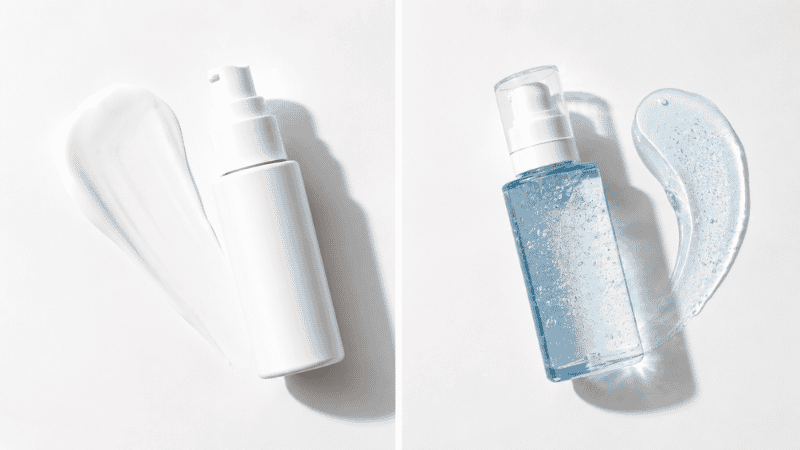
Chemical sunscreens (containing ingredients such as avobenzone, octinoxate, homosalate, or oxybenzone) work by absorbing UV radiation and converting it to heat through a photochemical reaction. They are often lighter, more cosmetically elegant in their basic form, and easier to formulate invisibly into skin-toned products. However, some chemical filters — particularly avobenzone — are inherently photounstable and degrade on UV exposure, requiring stabilisers to maintain efficacy. Some chemical filters have also raised questions around hormonal disruption and systemic absorption, though the regulatory consensus is that approved chemical filters at permitted concentrations are safe.
Mineral sunscreens (containing titanium dioxide, zinc oxide, or both) work by physically scattering and reflecting UV radiation at the skin’s surface. They do not degrade on UV exposure — they remain stable throughout the day without requiring photostabilisers. They begin protecting immediately upon application (chemical sunscreens require 15–20 minutes to bind to skin before becoming fully effective). And for mature skin with a potentially compromised barrier or heightened sensitivity, the absence of the photochemical reaction means less potential for irritation, flushing, or reactive responses.
The trade-off has historically been cosmetic: mineral filters, being larger particles, can create a white cast on the skin. This is the issue that modern formulation technology — specifically micronised and nano-scale particle development — has been directly addressing.
Titanium Dioxide Sunscreen — UVB Specialist and Formulation Foundation
Titanium dioxide is the most widely used UV filter in mineral sunscreens, for reasons that go beyond its protective properties. As a pigment, it is chemically stable, non-irritating, and has an extensive safety record in cosmetic formulations. It provides excellent UVB protection — the most clinically significant form of protection for preventing burns and DNA damage in the epidermis.
In luxury formulations, TiO₂ is used in micronised form: particles that are small enough to reduce visible white cast significantly while remaining large enough (based on current research) not to penetrate intact skin. The 2011 study published in PMC (PMC3781714) by Smijs and Pavel, reviewing evidence on titanium dioxide nanoparticles in sunscreens, found that nano-scale TiO₂ particles do not penetrate beyond the outer layers of the stratum corneum in intact skin — they do not enter the dermis or systemic circulation.
Zinc Oxide Sunscreen Benefits — The UVA Coverage TiO₂ Cannot Provide Alone
Zinc oxide is TiO₂’s essential complement in any genuinely broad-spectrum mineral formula. Its UV absorption spectrum extends fully across the UVA range (320–400nm), providing the coverage that titanium dioxide’s photochemistry cannot match at longer wavelengths.
Beyond its UV coverage, ZnO has additional properties that make it particularly valuable for mature skin. It has well-documented anti-inflammatory properties. It is among the gentlest UV filters available — it is used in formulations for newborns and severely sensitive skin precisely because of its low irritation profile. And unlike some chemical filters, it does not degrade on sun exposure, meaning that the protection it offers at the beginning of the day remains consistent through the afternoon.
For mature skin managing concurrent concerns — redness, post-inflammatory hyperpigmentation, barrier sensitivity — a ZnO-dominant mineral formula addresses photoprotection while simultaneously supporting, rather than challenging, the skin’s inflammatory balance.
Are Titanium Dioxide Nanoparticles Safe? What the Research Actually Shows
This is the question that has caused significant consumer anxiety and, consequently, driven many people away from mineral sunscreens toward chemical alternatives. The scientific answer is more reassuring than the conversation around it suggests.
The concern about nanoparticles in sunscreen centres on whether particles small enough to be cosmetically invisible might also be small enough to penetrate the skin barrier and enter systemic circulation — where their effects would be unknown. This is a legitimate scientific question, and it has been extensively studied.
The weight of current evidence — reviewed in the PMC study referenced above, and in subsequent research — consistently shows that nano-scale TiO₂ and ZnO particles do not penetrate through intact, healthy skin to reach the dermis or bloodstream. They remain in the stratum corneum, the outermost layer of dead skin cells, where they scatter and reflect UV radiation without entering living tissue.
The caveat: penetration studies on compromised skin — abraded, sunburned, or significantly barrier-disrupted skin — show different results. For skin with significant barrier compromise, a non-nano mineral formula (with larger particles that are definitively non-penetrating, at the cost of some white cast) may be a more conservative choice. For intact, healthy skin, the current evidence does not support the conclusion that nano-mineral sunscreens pose a systemic risk.
Regulatory bodies including the European Commission’s Scientific Committee on Consumer Safety (SCCS) and the FDA have both reviewed the nanoparticle safety data and concluded that TiO₂ and ZnO at permitted concentrations in sunscreens are safe for topical application.
Sunscreen for Aging Skin — What Changes After 40 and What to Look For
Mature skin — particularly skin over 40 with some degree of barrier thinning and reduced sebum production — interacts with sunscreen formulas differently than younger skin. Choosing a formula calibrated for this interaction improves both compliance (you’ll use it consistently) and efficacy.
What to look for in sunscreen for aging skin:
Hydrating base ingredients. Mature skin benefits from SPF formulas built on a moisturising base — containing hyaluronic acid, glycerin, ceramides, or niacinamide — rather than alcohol-heavy or matte-finish formulas designed for oily younger skin. A sunscreen that simultaneously provides hydration reduces the number of steps in the morning routine, improving the likelihood of consistent use.
Antioxidant enrichment. Some of the most sophisticated luxury mineral sunscreens now include antioxidant complexes — Vitamin C derivatives, Vitamin E, resveratrol, or niacinamide — alongside the UV filters. UV radiation generates free radicals that SPF alone cannot neutralise; antioxidants provide a complementary layer of protection against oxidative damage. This combination addresses photoprotection at both the physical (UV blocking) and biological (free radical neutralisation) levels.
Tinted formulas. For mature skin with hyperpigmentation concerns, a tinted mineral SPF serves a dual purpose: the iron oxide pigments in tinted formulas provide additional protection against visible light (which contributes to melasma and post-inflammatory hyperpigmentation) while simultaneously providing coverage that reduces the need for foundation. Many luxury mineral sunscreens in tinted versions are genuinely complexion-finishing products.
Texture appropriate to the skin type. Dry or normal-dry mature skin benefits from cream or serum-textured SPF. Combination mature skin may find a fluid formula more comfortable. The goal is finding a texture you’ll apply generously and willingly — because adequate quantity (approximately 1/4 teaspoon for the face and neck) matters as much as SPF number.
Does Sunscreen Go Before or After Moisturizer — The Definitive Answer
Sunscreen goes last in the morning routine — after all serums, treatments, and moisturiser, and before any makeup application. This is not stylistic preference; it reflects the functional requirement of UV filters.
For mineral sunscreens specifically: the UV-scattering function of TiO₂ and ZnO requires the particles to sit at or near the skin’s surface, forming an uninterrupted physical layer. Applying a moisturiser or serum over mineral SPF dilutes and disrupts this layer, reducing its effective protection. Sunscreen must be the last skincare step applied to ensure the UV filter layer remains intact.
The complete morning sequence: Cleanse → Vitamin C serum (allow to absorb) → Peptide serum if using → Eye cream → Moisturiser → Titanium dioxide sunscreen (generous application, last step)
For a detailed breakdown of the complete layering sequence — including where each active sits relative to SPF — see our complete guide to how to layer anti-aging skincare [→ /serum-before-or-after-moisturizer/].
On reapplication: SPF degrades with UV exposure and physical removal (sweating, touching the face). Reapplication every two hours during significant outdoor exposure is recommended. For indoor days with limited UV exposure, morning application followed by top-up via a tinted SPF powder or cushion compact is a practical alternative to full reapplication over makeup.
Do I Need Sunscreen Indoors — The Honest Answer
Yes — with important nuance about which type.
UVB rays, responsible for sunburn and the most acute DNA damage in the epidermis, do not significantly penetrate standard window glass. If you work away from windows in a controlled indoor environment, UVB exposure is minimal.
UVA rays — the longer wavelengths responsible for photoaging and collagen breakdown — penetrate standard window glass readily. Research has demonstrated that UVA exposure through windows contributes meaningfully to the asymmetric facial aging seen in long-term drivers (more pronounced aging on the window-side of the face) and in people who work near windows. If you spend significant time near windows — in a home office, in a car, or in a glass-fronted building — daily SPF with UVA protection is warranted regardless of whether you go outside.
The practical guideline: if you sit near a window for more than two hours during daylight, daily SPF is appropriate. If your indoor environment has no significant window exposure, the case for daily indoor SPF is less urgent — though many dermatologists still recommend the habit as the simplest way to ensure UV protection on days when outdoor exposure is unplanned.
Does Sunscreen Cause Breakouts — And How to Find a Mineral Formula That Doesn’t
The association between sunscreen and breakouts is real but not universal, and it is significantly more addressable than most people realise.
Chemical sunscreen formulas are more frequently implicated in breakouts, for several reasons: some chemical filters are comedogenic; the emollients used to stabilise them tend toward heavier textures; and the photochemical reaction on skin generates a small amount of heat that can exacerbate congestion in acne-prone skin.
Mineral sunscreens are generally less problematic for breakout-prone skin, for equally specific reasons: ZnO has anti-inflammatory and antimicrobial properties that have been used in acne treatment formulations; TiO₂ and ZnO are non-comedogenic at standard concentrations; and the physical scattering mechanism generates no heat.
If you’ve experienced breakouts with mineral sunscreens, the more likely culprit is the formulation base rather than the mineral filters themselves. Heavy creams, silicone-dense formulas, and certain emollients can contribute to congestion. Look for mineral formulas labelled non-comedogenic, with lightweight gel, fluid, or serum textures, and minimal silicone content. Many of the best luxury mineral sunscreens designed for combination or oily-mature skin use fluid emulsions that sit lightly on the skin without contributing to pore congestion.
Is Luxury Mineral Sunscreen Worth the Premium?
This is a question Beaudore is committed to answering honestly, and the answer — as with most luxury skincare categories — is: it depends on what you’re paying for.
Where the premium is functionally justified:
Micronised particle technology. The most sophisticated luxury mineral formulas invest significantly in reducing particle size and surface coating to minimise white cast while maintaining UV efficacy. The sensory difference between a well-formulated luxury mineral SPF and a basic drugstore zinc oxide cream is real and meaningful for daily use compliance.
Antioxidant integration. Luxury SPF formulas that combine UV filters with high-concentration, well-stabilised antioxidants (Vitamin E, resveratrol, niacinamide, Vitamin C derivatives) are providing a more complete photoprotection package than a basic mineral filter alone. The added functional value justifies a price differential.
Tinted formulas with iron oxide. Well-formulated tinted luxury SPF adds visible light protection against melasma-triggering wavelengths that untinted SPF does not address. For mature skin managing hyperpigmentation, this is a genuine functional addition.
Where the premium is primarily experiential:
A luxury SPF that provides extraordinary texture and packaging but uses the same TiO₂ and ZnO concentrations as a well-formulated drugstore alternative is providing a superior experience, not superior photoprotection. SPF protection is determined by filter concentration and coverage, not by price point.
The honest guidance: invest in a luxury mineral SPF if the sensory experience is what makes you apply it consistently and generously. An $80 SPF you use every day at adequate quantity outperforms a $20 SPF you underapply or skip. The best sunscreen is the one you will actually use.
The 5-Minute Anti-Aging SPF Protocol for Mature Skin
For mornings when time is limited, the minimum effective protocol is simpler than most skincare content acknowledges:
Cleanse or rinse (60 seconds) → Vitamin C serum (60 seconds to absorb) → Titanium dioxide sunscreen (apply generously, including neck and décolletage)
Three steps. Under five minutes. This is the morning routine with the strongest evidence base for slowing visible skin aging. Everything else — the multiple serums, the eye cream, the elaborate layering — adds meaningful value, but this core delivers the most significant anti-aging return per minute invested.
The key is quantity. Most people apply approximately half the SPF they need for the tested protection level. For a face and neck, approximately one-quarter teaspoon of formula (or two to three finger lengths of product) is the amount used in SPF testing and the amount that delivers the labelled protection factor.
When to Seek Guidance on Sun Protection
SPF for anti-aging purposes is self-navigable for most people. Professional input is relevant if:
You have a history of melanoma or pre-cancerous lesions — where the selection and application of photoprotection should be guided by a dermatologist. If you have melasma or persistent hyperpigmentation that is not responding to topical treatment — where the addition of iron oxide tinting and visible light protection may be discussed with a specialist. Or if you are considering photosensitising prescription medications (certain antibiotics, retinoids, or acne treatments) where SPF requirements change significantly.
FAQ
Does titanium dioxide sunscreen leave a white cast? In conventional formulations, yes. In luxury mineral formulas using micronised or nano-scale TiO₂ particles, the white cast is significantly reduced and often eliminated entirely on medium and deeper skin tones, and minimal on lighter skin tones. Tinted mineral SPF eliminates the white cast concern entirely by incorporating pigments that neutralise the white tone. The white cast that many people associate with mineral sunscreen reflects formulas from a decade or more ago, not the current generation of luxury mineral SPF technology.
What SPF should I use for anti-aging purposes — SPF 30 or SPF 50? SPF 30 blocks approximately 97% of UVB rays; SPF 50 blocks approximately 98%. The mathematical difference is modest, but SPF 50 provides a meaningful buffer for real-world underapplication — most people apply 25–50% of the amount used in SPF testing, which effectively halves the protection factor. A well-applied SPF 30 outperforms an inadequately applied SPF 50. If you tend to apply generously, SPF 30 is adequate. If you apply minimally, SPF 50 provides more practical margin.
Can I use the same sunscreen on my body and face? Technically yes, but practically, body formulas are often not calibrated for the specific needs of facial skin — they may be thicker, more fragrant, or formulated with ingredients that cause facial congestion. A dedicated facial SPF, formulated for the sensory requirements and skin characteristics of facial skin, typically provides a better daily use experience for the face.
Mineral vs chemical sunscreen — which is better for mature skin? Mineral sunscreen is generally preferable for mature skin for three reasons: the immediate-on protection (no 15-20 minute absorption wait), the absence of photochemical heat generation (less relevant irritation risk for sensitised mature skin), and ZnO’s anti-inflammatory properties. Chemical sunscreens are not inherently inferior, and some luxury chemical formulas offer excellent photostability — but the mineral option aligns more naturally with the needs and concerns of mature skin.
Does sunscreen need to be reapplied if I’m indoors all day? If you’re not near windows, morning application is generally sufficient for an indoor day. If you’re near windows for extended periods, reapplication around midday is advisable — UVA penetrates glass, and the morning’s SPF layer degrades over time. A tinted mineral SPF powder or cushion compact makes midday reapplication over makeup practical and quick.
How does sunscreen interact with retinol — can I apply both? Yes, but in different sessions. Retinol belongs in the evening (it is photosensitive and its mechanism aligns with the skin’s nighttime repair cycle); sunscreen belongs in the morning (it protects the skin during the period of UV exposure). They do not compete or interfere. Retinol use actually makes consistent daily SPF more important, not less — because retinol-stimulated skin renewal creates newer, more UV-sensitive cells at the surface. See our guide on how long retinol takes to work for the complete protocol.
The Non-Negotiable Step
Every anti-aging guide eventually returns to the same conclusion, and this one is no exception: if you do one thing differently after reading this, apply a generous amount of a broad-spectrum titanium dioxide and zinc oxide mineral sunscreen every morning, as the final step before leaving your bathroom.
Not because it’s fashionable. Not because your skincare influencer uses it. Because the evidence, accumulated over decades of randomised trials and longitudinal studies, is unambiguous: consistent daily photoprotection is the most effective topical anti-aging intervention available without a prescription. Everything else in a serious routine amplifies results that SPF is protecting.
For the complete routine that places SPF in its proper context alongside retinoids, Vitamin C, and peptides, our guide to the full skincare routine for aging skin covers the architecture in detail [→ /skincare-routine-for-aging-skin/].
And for the collagen science that explains precisely why UV protection matters so specifically for structural skin aging, our guide on how to stimulate collagen production covers the MMP mechanism and why SPF is the intervention that makes every other collagen-stimulating active more effective [→ /how-to-stimulate-collagen-production/].
References
- Hughes, M.C.B., et al. (2013). Sunscreen and prevention of skin aging: A randomized trial. Annals of Internal Medicine, 158(11), 781–790.
- Smijs, T.G., & Pavel, S. (2011). Titanium dioxide and zinc oxide nanoparticles in sunscreens: focus on their safety and effectiveness. Nanotechnology, Science and Applications, 4, 95–112. PMC3781714.
- Diffey, B.L. (2001). When should sunscreen be reapplied? Journal of the American Academy of Dermatology, 45(6), 882–885.
- Krutmann, J., et al. (2017). The skin aging exposome. Journal of Dermatological Science, 85(3), 152–161.
- Lim, H.W., et al. (2017). Current challenges in photoprotection. Journal of the American Academy of Dermatology, 76(3 Suppl 1), S91–S99.
- Ganceviciene, R., et al. (2012). Skin anti-aging strategies. Dermato-Endocrinology, 4(3), 308–319.