
You’ve been using the same moisturiser for years — maybe the same one for most of your 30s. It worked. Your skin felt comfortable after cleansing, the tightness resolved, and you never thought much about it. Then somewhere in your early-to-mid 40s, without any obvious trigger, it stopped being enough. The moisturiser you applied in the morning is gone by noon. Your skin feels tight again by evening. In winter, the dryness becomes a texture issue — fine flakiness that no amount of product seems to fully resolve.
You haven’t changed anything. Your skin has.
Dry aging skin is one of the most common and most mismanaged skin concerns for women over 40 — not because the solutions don’t exist, but because the understanding of what is actually causing the dryness is usually incomplete. Applying more of the same moisturiser to aging skin that has become structurally dry is like trying to fill a bath with the drain open. The problem is not the amount of moisture you’re adding. The problem is that the barrier holding moisture in has changed — and most moisturisers are not formulated to address that.
This guide explains the biology, identifies the specific failure modes of standard moisturising approaches for mature skin, and provides the complete routine framework that addresses dry aging skin at every level it operates.
Key Takeaways
- The National Institute on Aging (NIA) documents that aging skin produces less oil from the sebaceous glands and shows reduced elasticity — contributing directly to the chronic dryness that many women experience in their 40s and 50s. This is a biological change, not a hydration failure.
- Dry aging skin operates through two distinct mechanisms that require different interventions: surface dehydration (insufficient water content in the stratum corneum, addressed by humectants) and barrier lipid insufficiency (insufficient ceramides and sebum to seal moisture in, addressed by barrier-supportive lipids). Most single-product moisturisers address only one.
- After menopause, oestrogen’s direct role in ceramide synthesis means that hormonal dry skin has a specific biological driver — reduced barrier lipid production — that makes it different from simple seasonal or environmental dryness, and requires a ceramide-centred approach rather than simply more moisturiser.
- Retinol does not have to worsen dryness in mature skin. The right protocol — low concentration, adequate barrier support, the sandwich method — allows the structural anti-aging benefits of retinoids without the dehydration that causes most women to abandon them.
- The three-layer hydration system (humectant → barrier lipid → occlusive) addresses dry aging skin more completely than any single product at any price point. This sequence is what makes the difference between comfortable skin and skin that is dry again by evening.
Why Does Skin Get Drier With Age — The Biology Explained
The dryness that develops in mature skin is not the same as the dryness of youth — the kind that resolved with a single good moisturiser and a glass of water. Understanding what actually changes removes the frustration of repeatedly trying approaches that are not matched to the biology.
Sebum production declines. The sebaceous glands produce progressively less lipid-based sebum from the late 20s onward. Sebum is not simply “grease” — it is the natural occlusive layer that coats the stratum corneum surface, significantly slowing transepidermal water loss (TEWL). As production declines through the 30s and 40s, the skin loses its most fundamental moisture-retention mechanism. This is why skin that was “balanced” or even “slightly oily” in the 20s becomes noticeably drier in the 40s without any change in habits or environment.
Ceramide synthesis decreases. Ceramides are the structural lipids of the stratum corneum matrix — the “mortar” between skin cells that prevents moisture from escaping between them. Their synthesis is influenced by multiple factors that decline with age, including oestrogen levels. Research published in Skin Pharmacology and Physiology documented measurably lower ceramide levels in aged compared to young skin. A stratum corneum with reduced ceramides is structurally compromised — water escapes more readily regardless of how much is applied topically.
Hyaluronic acid content declines. The dermis naturally contains hyaluronic acid that holds water within the tissue, contributing to the skin’s characteristic plumpness and suppleness. Research published in the Journal of Investigative Dermatology documented significant reductions in HA content in aged skin — contributing to reduced intrinsic hydration capacity at the dermal level that topical humectants partially but not fully compensate for.
Cellular turnover slows. The skin’s renewal cycle extends from approximately 28 days at 25 to 45–60 days by 45. Older cells accumulate at the surface for longer — cells that are more dehydrated, less lipid-rich, and less reflective than freshly generated cells. The surface of mature skin is, in a literal sense, populated by older cells holding less moisture than the surface of younger skin.
Each of these four changes requires a specific type of product response. The fundamental error in managing dry aging skin is applying a single “moisturiser” — which typically addresses at most two of these four issues — and expecting it to resolve all of them.
Dry Skin Despite Moisturizing — Why One Product Is Never Enough
This is the experience that most women with dry aging skin eventually describe: “I moisturise twice a day and my skin is still dry.” The confusion is understandable, because the word “moisturiser” implies that it provides moisture — when in reality, most moisturisers primarily provide either temporary surface comfort or surface water attraction, neither of which addresses the underlying barrier deficit.
The humectant-only failure mode. Hyaluronic acid serums, glycerin-based gels, and water-rich essences are humectants — they attract water to the skin surface. In a humid environment with an intact skin barrier, this works well: water is attracted and retained. In dry aging skin with a compromised barrier and in low-humidity environments, humectants can draw water from deeper skin layers to the surface where it then evaporates — leaving skin net-drier than before application. A humectant without an immediate sealing layer is an incomplete solution for dry aging skin.
The light lotion failure mode. Many “moisturisers” are oil-in-water emulsions with a high water content and a relatively small lipid fraction. They feel pleasant, absorb quickly, and provide temporary comfort. What they typically do not provide is the ceramide NP, AP, and EOP combination that the stratum corneum’s barrier matrix requires, at concentrations sufficient to meaningfully address the structural lipid deficit of mature skin. They are comfort products, not barrier repair products.
The occlusive-only failure mode. Rich, heavy creams and balms that contain primarily occlusives (petroleum, beeswax, mineral oil) seal the surface effectively but do not provide the structural ceramides the barrier needs for lasting repair. They make dry aging skin feel better immediately and worse over time if used without the underlying structural work.
The solution is not finding the right single product. It is understanding that dry aging skin requires three different product types addressing three different levels of the skin’s hydration system — in the correct sequence.
How to Treat Dry Skin After Menopause — A Different Problem Requires a Different Approach
Post-menopausal dry skin deserves specific attention because its biological driver is different from age-related dryness alone — and this difference changes what works.
Oestrogen has direct receptors on keratinocytes and fibroblasts. Among its many skin-related functions, it directly stimulates the expression of ceramide synthesis enzymes — the biological machinery that produces the barrier lipids the stratum corneum depends on. When oestrogen declines in perimenopause and drops to sustained low levels after menopause, ceramide synthesis is directly impaired alongside all the other oestrogen-dependent skin functions (collagen synthesis, hyaluronic acid production, sebaceous activity).
The result is a skin that has lost its barrier lipid production capacity at a hormonal level — not just at a chronological aging level. Post-menopausal skin is managing a ceramide deficit that is both age-related and hormonally accelerated simultaneously. This is why the sudden-feeling dryness shift that many women describe in their early-to-mid 50s feels qualitatively different from the gradual dryness of the late 30s and 40s — because biologically, it is.
The treatment implication: Post-menopausal dry skin should centre the routine around ceramide replenishment first, with humectants as supporting ingredients, and occlusives as the sealing layer. The order of priority is different from pre-menopausal dry skin management, where humectants may have been the primary intervention.
For the complete science of ceramide barrier repair and product selection for post-menopausal skin, see our dedicated guide to ceramides moisturizer [→ /ceramides-moisturizer/].
The Three-Layer Hydration System for Dry Aging Skin
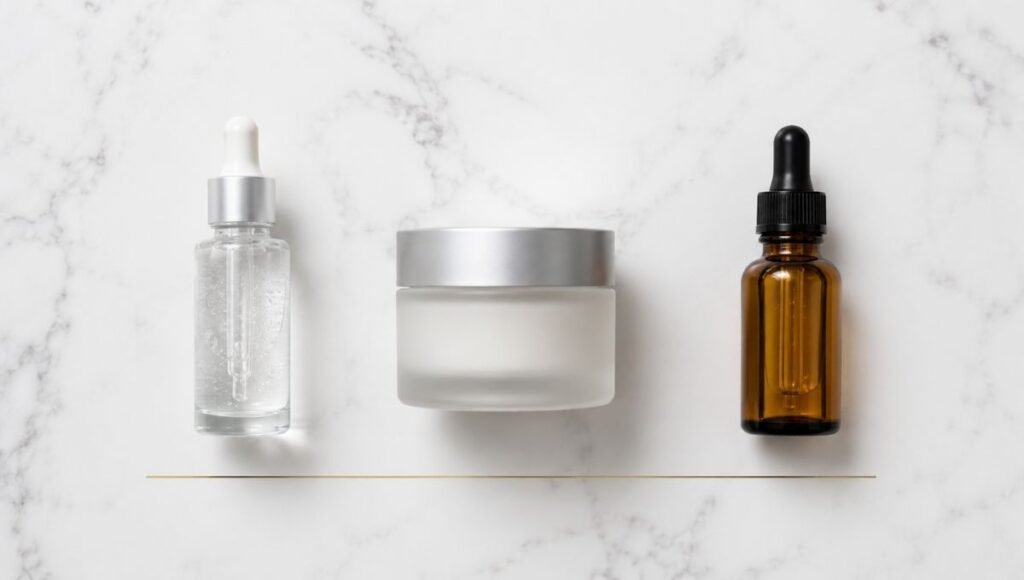
This is the framework that transforms “applying more moisturiser” into “addressing dry aging skin at every level it operates.” Each layer targets a different aspect of the problem; each layer depends on the previous one to function correctly.
Layer 1: Humectant (attract water to the surface)
A hyaluronic acid serum — specifically a multi-molecular-weight formulation — applied to slightly damp skin provides the water-attracting foundation. High-molecular-weight HA creates a surface hydration film; lower-molecular-weight HA penetrates slightly into the upper epidermis. Applied to damp skin (or after a light mist in dry environments), the HA draws surface moisture into itself rather than pulling from deeper layers.
The key: apply to slightly damp skin and move immediately to Layer 2 within 30–60 seconds, before the surface moisture can evaporate. This is the step most routines skip or delay, and its omission is often why “HA doesn’t work for me” is such a common complaint.
For the complete HA application guide including the dry-climate paradox and molecular weight science, see our guide to hyaluronic acid moisturizer [→ /hyaluronic-acid-moisturizer/].
Layer 2: Barrier lipid repair (seal moisture in)
A ceramide-containing moisturiser applied within 30–60 seconds of the HA serum provides the structural lipid layer that converts the surface hydration into retained hydration. Look for ceramide NP, AP, and EOP alongside cholesterol and free fatty acids — the physiological ratio that most closely matches the stratum corneum’s natural lipid composition.
For dry aging skin, the texture of the ceramide moisturiser matters. A cream formulation (oil-in-water emulsion with meaningful lipid content) is generally more appropriate than a lotion or gel for post-35 dry skin. The weight of the formula should increase as the dryness and sebum deficit increases — a post-menopausal woman in winter typically needs a significantly richer ceramide cream than a 35-year-old with mild dryness.
Layer 3: Occlusive seal (prevent overnight moisture loss)
Squalane — the skin-identical lipid that mimics natural sebum — provides the final seal over the ceramide moisturiser, significantly reducing overnight TEWL. As sebum production declines, the natural occlusive layer the skin once provided independently requires deliberate supplementation. Three to five drops of squalane pressed gently into skin after the ceramide moisturiser completes the system.
For dry aging skin specifically, squalane is most valuable as the evening final step — applied after the ceramide moisturiser, it creates the overnight lipid seal that allows the barrier to regenerate during the skin’s peak repair cycle. For the complete squalane science and its role in the three-layer system, see our guide to squalane moisturizer [→ /squalane-moisturizer/].
Facial Oil for Dry Mature Skin — The Final Sealing Layer
The question of whether dry mature skin should use a facial oil — and which one — is worth addressing directly, because oil recommendations for aging skin are often either too cautious (“oils will clog pores”) or too enthusiastic (“any oil will hydrate you”) to be useful.
For dry aging skin, a facial oil used as the final evening step provides three specific benefits: it functions as an occlusive seal over the ceramide moisturiser (reducing TEWL significantly), it delivers additional lipid-based nourishment that mimics the sebum the skin is no longer producing adequately, and — depending on the oil’s fatty acid profile — it may provide additional antioxidant or anti-inflammatory benefit.
Squalane is the most universally appropriate facial oil for dry aging skin. Its saturated hydrocarbon structure means it does not oxidise under UV exposure (unlike many unsaturated plant oils), is non-comedogenic, and integrates with the skin’s own sebum chemistry more naturally than exotic plant oils.
Marula oil is a close second for dry aging skin — high in oleic acid (a skin-compatible fatty acid), rich in antioxidants, and well-tolerated by most skin types. It is heavier than squalane and more appropriate for very dry or post-menopausal skin than for mild dryness.
What to avoid for dry aging skin: Oils with high linoleic acid content (rosehip, evening primrose) are often recommended for oily and acne-prone skin but are less appropriate as the primary facial oil for dry aging skin, where oleic acid-dominant profiles provide better barrier integration. They are also more prone to oxidation — becoming pro-inflammatory on the skin surface — which makes them less suitable for daily use in a routine designed to minimise inflammation.
Niacinamide for Dry Skin — Barrier Repair From the Inside Out
Niacinamide’s role in dry aging skin goes beyond its brightening and sebum-regulating reputation. For dry mature skin, its most relevant mechanism is barrier lipid synthesis stimulation.
Niacinamide at 4–5% directly stimulates the production of ceramides, fatty acids, and other barrier lipids — addressing the barrier lipid deficit of dry aging skin from the cellular production side, while topical ceramide moisturisers address it from the replenishment side. Used together, niacinamide in the serum and ceramides in the moisturiser provide barrier support from two directions simultaneously: stimulating the skin’s own production while supplementing what that production can no longer adequately supply.
For dry aging skin, consistent twice-daily niacinamide use — in a serum or a moisturiser that lists it within the first half of its ingredient list — produces measurable improvements in barrier function over 4–8 weeks. It is also one of the most universally well-tolerated actives in mature skin, making it appropriate even for skin that is experiencing increased sensitivity alongside the dryness.
For the complete niacinamide science including the clinical evidence for barrier improvement and the optimal concentration range, see our guide to niacinamide skincare [→ /niacinamide-skincare/].
Retinol for Dry Skin — How to Use It Without Making Dryness Worse
The most common reason women with dry aging skin abandon retinol — and it is genuinely the most common reason — is that its adjustment-phase dryness tips skin that is already dry into uncomfortable, sometimes reactive territory. The conclusion drawn is that “retinol doesn’t work for dry skin.” The more accurate conclusion is that the standard retinol introduction protocol is not designed for skin with a pre-existing barrier deficit.
Retinol accelerates cellular turnover, which temporarily disrupts the barrier lipid completeness of newly generated cells — creating a period during which TEWL is higher than baseline. In skin with an already-compromised barrier (as dry aging skin typically has), this additional barrier disruption produces dryness and sensitivity that can be genuinely uncomfortable. The answer is not avoiding retinol — it is modifying the protocol to protect the barrier during introduction.
The dry skin retinol protocol:
Start lower and progress more slowly. Begin at 0.025% (the lowest widely available OTC concentration), every fourth evening for the first month rather than every third. The slower introduction gives the barrier more recovery time between applications.
Use the sandwich method. Apply a ceramide-containing moisturiser before the retinol (allowing it to absorb, then applying retinol on top), then apply another ceramide moisturiser over the retinol after 60–90 seconds. This “sandwich” significantly reduces barrier disruption without meaningfully reducing retinol’s efficacy.
Follow with squalane. As the final evening step over the ceramide moisturiser, squalane provides the occlusive seal that prevents the additional TEWL of the adjustment phase from becoming problematic.
Assess at six weeks, not three. Dry skin often shows more adjustment-phase sensitivity in weeks 2–4 and begins settling in weeks 5–8 as the barrier adapts. Assessing whether retinol is “working” or “suiting” the skin at three weeks frequently leads to premature abandonment.
For the complete retinoid introduction protocol including concentration progression and timeline expectations, see our guide to how long retinol takes to work [→ /how-long-does-retinol-take-to-work/].
Skincare Routine for Dry Aging Skin — Morning and Evening
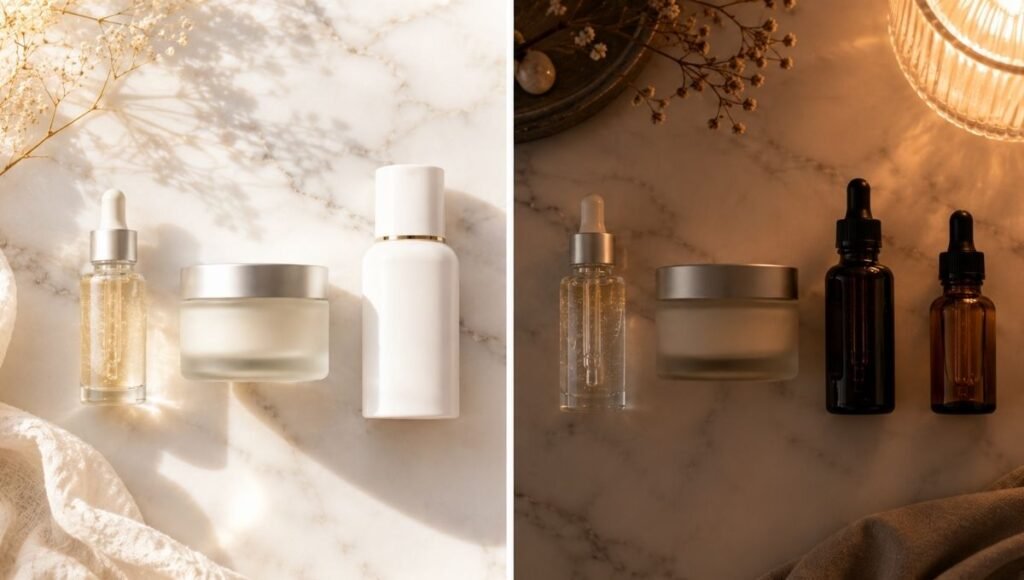
Morning routine for dry aging skin:
Gentle cleanse or water rinse — never a foaming, sulphate-containing cleanser that strips what little natural sebum remains. Cream or oil-based cleansers are appropriate for dry aging skin even in the morning.
Vitamin C serum — applied to dry skin, 60–90 seconds to absorb. For dry aging skin, a slightly gentler Vitamin C formulation (ascorbyl glucoside or 3-O-Ethyl Ascorbate at 10%) may be better tolerated than high-concentration L-ascorbic acid during periods of barrier compromise.
Niacinamide serum or toner — after Vitamin C has absorbed.
Hyaluronic acid serum — applied to slightly damp skin immediately after niacinamide.
Ceramide cream — within 30–60 seconds of HA. For very dry or post-menopausal skin, a rich ceramide cream rather than a lotion.
SPF 30+ mineral — final morning step. For dry aging skin, choose a hydrating SPF formulation that contains additional humectants or emollients — avoiding the alcohol-containing, matte-finish SPFs designed for oily skin.
Evening routine for dry aging skin:
Oil cleanser — even on evenings without makeup, an oil or balm cleanser for dry aging skin removes daytime SPF without the barrier stripping of a foaming cleanser.
Gentle second cleanse — optional cream or micellar water for complete cleansing without disruption.
Niacinamide serum — the barrier-building active that dry aging skin benefits from twice daily.
Ceramide moisturiser (first application — sandwich method if using retinol).
Retinol (on retinol evenings, 2–3 per week) — applied after the first ceramide application has absorbed.
Ceramide moisturiser (second application) — over retinol on retinoid evenings; the primary evening moisturiser on non-retinoid evenings.
Squalane — 3–5 drops pressed gently over the ceramide moisturiser as the final occlusive seal.
The simplified version (five minutes): Gentle cleanse → ceramide cream → SPF (morning) Oil cleanse → ceramide cream → squalane (evening)
This simplified routine addresses the core barrier deficit without the full active ingredient sequence — appropriate for periods of skin stress or for beginners establishing the foundation before introducing actives.
When Dry Aging Skin Needs Medical Attention
The vast majority of dry aging skin responds to the routine framework described in this guide within 4–8 weeks of consistent implementation. Several presentations warrant professional assessment rather than topical management alone:
Persistent itch that does not respond to barrier repair. Chronic skin itching (pruritus) in older adults can reflect internal conditions including thyroid dysfunction, kidney disease, liver conditions, or certain medications — not just barrier compromise. The NIA specifically notes that pruritus in older adults warrants medical evaluation if it is severe or does not respond to topical care.
Eczema or dermatitis that is spreading or severe. Atopic dermatitis, contact dermatitis, and seborrhoeic dermatitis can all present as or alongside dry aging skin. These conditions may require prescription treatment that topical OTC barrier repair cannot adequately address.
Rapid onset of new skin changes alongside dryness. If significant dryness appears suddenly and is accompanied by other changes — widespread rash, systemic symptoms, or unusual lesions — prompt medical evaluation is appropriate.
Dryness that does not improve after 8 weeks of consistent ceramide-centred barrier repair. A dermatologist can assess whether the dryness has an underlying cause that requires prescription intervention and provide guidance on prescription-strength formulations.
FAQ
Why is my skin so dry even though I moisturise every day? The most common reason is that the moisturiser is addressing surface comfort without repairing the underlying barrier. Mature skin that is chronically dry typically has a ceramide deficit — the structural lipids that prevent moisture from escaping between skin cells are insufficient. A moisturiser that primarily provides humectants (like a water-rich serum) will attract moisture to the skin surface but cannot retain it without ceramide barrier support. The solution is a three-layer approach: humectant serum → ceramide cream → occlusive oil, in sequence within one routine session.
Why does dry skin get worse after 40? Three simultaneous biological shifts accelerate dryness after 40: sebum production decreases (reducing the natural occlusive layer), ceramide synthesis declines (weakening the barrier’s moisture-retention capacity), and cellular turnover slows (accumulating older, less hydrated cells at the surface). After menopause, oestrogen’s direct role in ceramide synthesis means these shifts accelerate further. No single change in skincare habits causes this — it is a convergence of biological changes that requires a more deliberate skincare approach than the same routine that worked at 30.
Can retinol be used on dry aging skin? Yes — with protocol adjustments. Dry aging skin requires a modified retinol introduction: lower starting concentration (0.025%), less frequent initial application (every fourth evening), the ceramide sandwich method, and a squalane final seal. The adjustment phase may be longer than for normal or oily skin, but the structural anti-aging benefits of retinoids are available to dry aging skin with the right protocol. The most common mistake is stopping during weeks 2–4 of the adjustment phase before the skin has had time to adapt.
How to treat dry skin after menopause specifically? Post-menopausal dry skin has a specific hormonal driver — oestrogen decline directly reduces ceramide synthesis enzyme activity, producing a barrier lipid deficit that goes beyond age-related sebum reduction. The treatment priority is ceramide replenishment: a ceramide cream containing NP, AP, and EOP ceramides alongside cholesterol and fatty acids, applied twice daily, combined with niacinamide (which stimulates the skin’s own ceramide production). Squalane as a final evening occlusive completes the barrier support. This ceramide-centred approach is more effective for post-menopausal dry skin than increasing humectant use alone.
What is the best facial oil for dry mature skin? Squalane is the most universally appropriate facial oil for dry aging skin — saturated structure (no oxidation risk), non-comedogenic, and structurally similar to the skin’s own sebum that declining sebaceous glands are producing less of. Marula oil is a good alternative for very dry or post-menopausal skin, offering a richer oleic acid profile with antioxidant properties. Both are used as the final evening step over ceramide moisturiser, not as a replacement for the barrier lipid repair that ceramides provide.
Does niacinamide help with dry skin? Yes — through a mechanism that is separate from simple surface hydration. Niacinamide at 4–5% directly stimulates ceramide synthesis in keratinocytes, addressing the barrier lipid deficit of dry aging skin from the production side rather than just the replenishment side. Used consistently twice daily, it produces measurable improvements in barrier function and TEWL over 4–8 weeks. It is also extremely well-tolerated, making it one of the most valuable actives for sensitive, reactive, or barrier-compromised dry aging skin.
The Skin You Have Now
Dry aging skin is not a failure of effort. It is a biological shift that requires a biological response — one that is more specific than “use more moisturiser” and more targeted than any single product can provide.
The three-layer hydration system described in this guide — humectant serum, ceramide barrier repair, occlusive seal — addresses dry aging skin at every level where the biology has changed. It is not complicated in execution, but it does require understanding why each step exists and what it is doing. That understanding is what makes the difference between skin that is temporarily comfortable and skin that is genuinely, durably hydrated.
For the complete routine framework that places these hydration ingredients in the context of the full anti-aging approach, our guide to skincare for women over 40 covers the complete morning and evening architecture [→ /skincare-for-women-over-40/].
References
- National Institute on Aging. (2023). Skin care and aging. U.S. Department of Health & Human Services, National Institutes of Health. Retrieved from nia.nih.gov.
- Elias, P.M., & Feingold, K.R. (2006). Skin barrier function. Dermato-Endocrinology, 1(1), 12–16.
- Verdier-Sévrain, S., & Bonté, F. (2007). Skin hydration: A review of its molecular mechanisms. Journal of Cosmetic Dermatology, 6(2), 75–82.
- Zouboulis, C.C., & Makrantonaki, E. (2011). Hormonal therapy of intrinsic aging. Rejuvenation Research, 15(3), 302–312.
- Draelos, Z.D. (2010). The science behind skin care: Moisturizers. Journal of Cosmetic Dermatology, 17(2), 138–144.
- Ganceviciene, R., et al. (2012). Skin anti-aging strategies. Dermato-Endocrinology, 4(3), 308–319.
- Papakonstantinou, E., et al. (2012). Hyaluronic acid: A key molecule in skin aging. Dermato-Endocrinology, 4(3), 253–258.